I Analyzed 1,891 Reddit Posts About SaaS Marketing Pain. The Dominant Complaint Isn't What You'd Think.
I was doing everything by the book… ads were getting clicks… The problem was nobody was buying. Like I would get 300 visitors in a day and maybe 1 sale. 1
That post sat at 76 upvotes and 45 comments on r/Entrepreneur. The founder shut down their e-commerce brand six months later. The replies are full of other founders saying the same thing. Different products, same shape of pain.
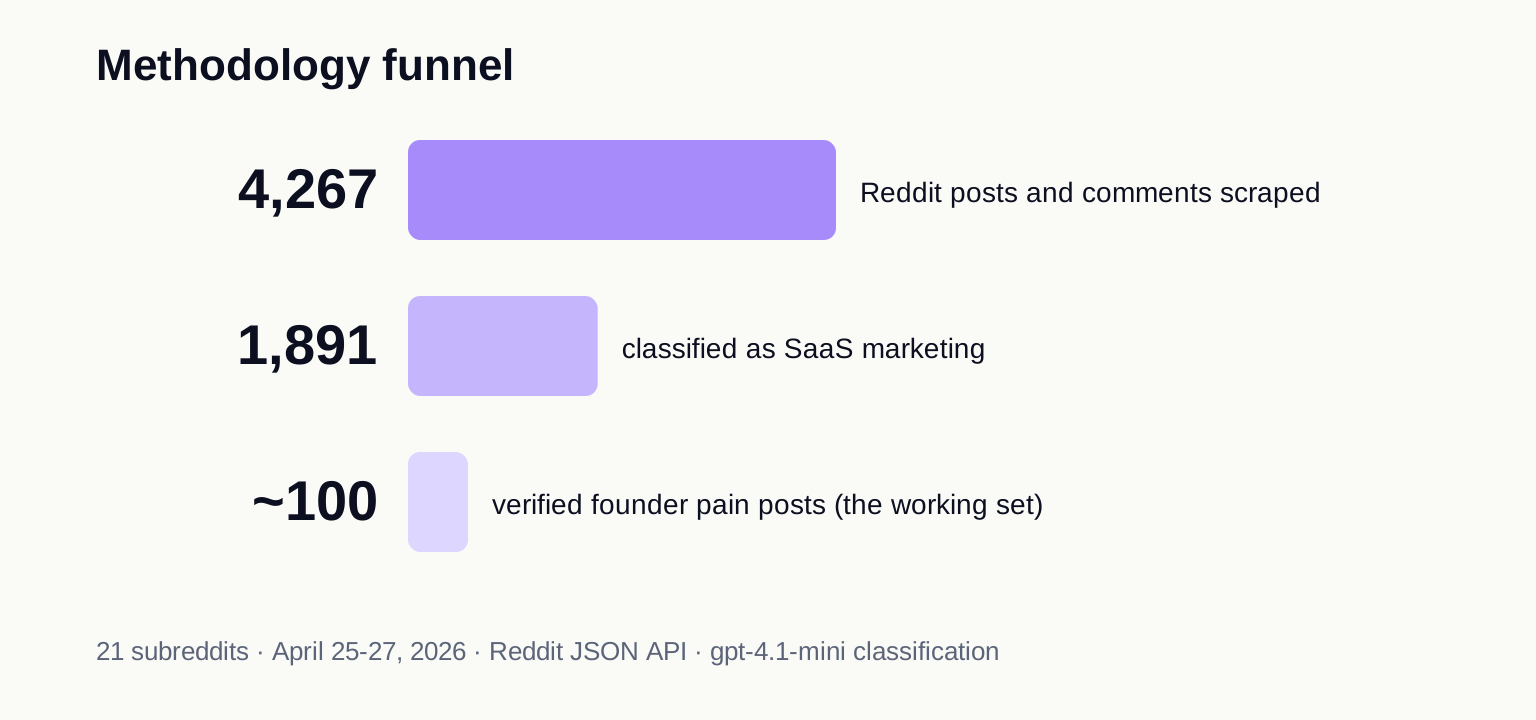
I scanned 1,891 SaaS-marketing posts across 21 subreddits over three days in late April 2026. Most weren’t pain. Some were tool launches, some were founders sharing tactics that were working, some were just noise from off-topic communities. What I cared about was the subset where founders were specifically complaining, pushing back on common advice, or warning others off a tactic. After filtering to ten actual founder communities, that gave me roughly 100 pain posts to read carefully. The patterns below come from those.
What I found wasn’t what I expected.
The dominant complaint isn’t “I can’t get traffic.” It’s three things. Founders don’t have a distribution strategy. The traffic they do get doesn’t convert. And the content they make sounds identical to every other AI-written blog in their niche.
Here’s what the corpus actually says, why each pattern is real, and what I’d do about it if I were starting my SaaS marketing in 2026.
TL;DR
- I scanned 1,891 SaaS-marketing posts across 21 subreddits over three days. After filtering to ten actual founder communities and the posts that were specifically complaints, the working set was about 100 pain posts.
- The dominant pain isn’t traffic generation. It’s distribution strategy, conversion confidence, and AI sameness in content.
- The pattern matches what Brian Balfour, Paul Graham, and Gartner have written about for years. Founders relearn it on Reddit, one shutdown at a time.
- “300 visitors a day, maybe 1 sale” was the most-engaged complaint I found.
- What I’d do: stop optimizing for top-of-funnel traffic alone. Start with distribution-channel fit, decision-stage conversion, and a voice that AI Overviews can’t generate.
How I pulled the data
I scraped 4,267 posts and comments from 21 subreddits over three days in late April 2026. Each one got passed through an LLM that classified the topic and the kind of post it was (a complaint, a tactic someone was endorsing, a warning, a counter-argument, a question, etc.) and rated its confidence on the call.
For this article, I narrowed it down to:
- Posts the model classified as SaaS marketing
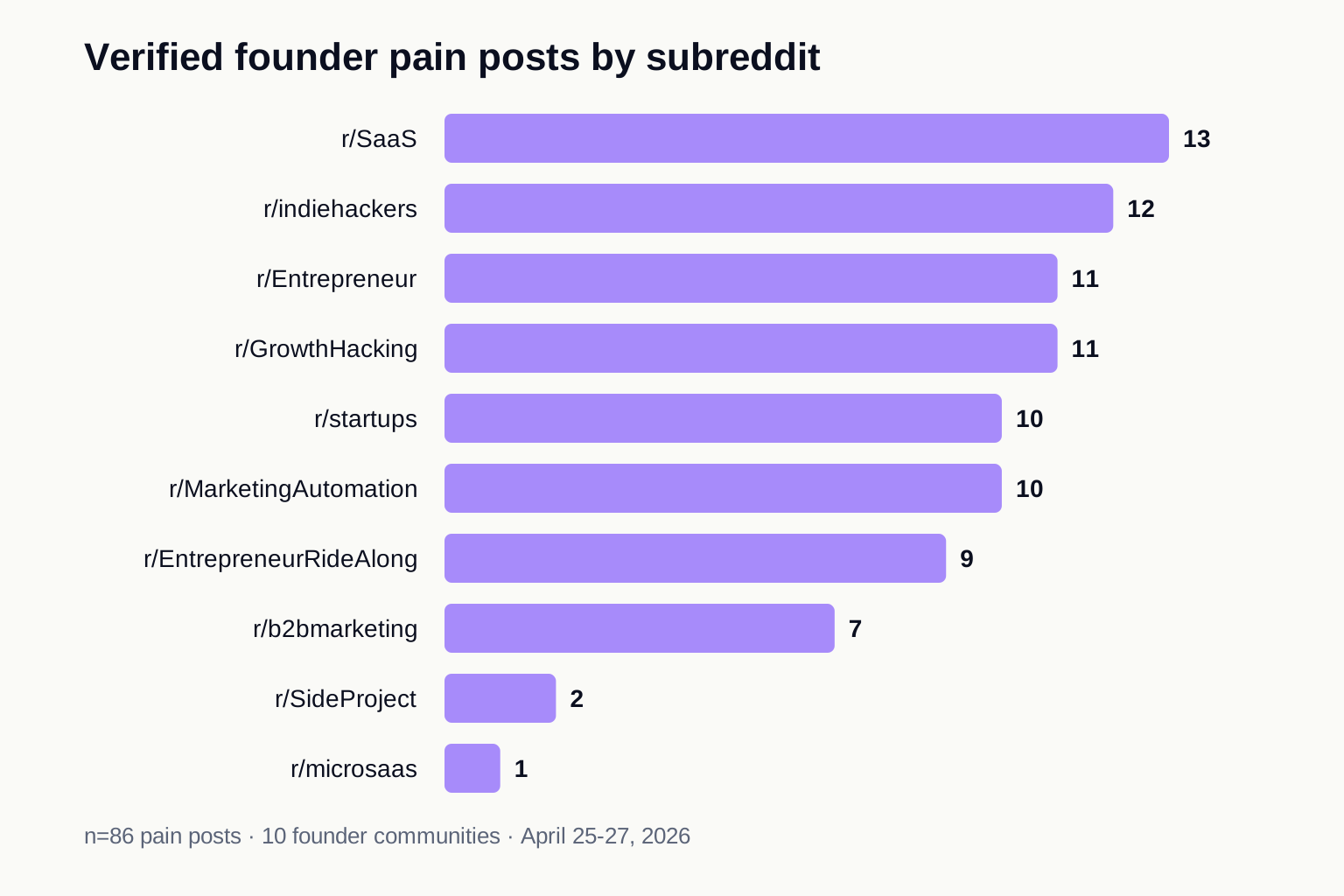
- Posts from ten actual founder communities (r/SaaS, r/indiehackers, r/Entrepreneur, r/startups, r/EntrepreneurRideAlong, r/microsaas, r/SideProject, r/GrowthHacking, r/b2bmarketing, r/MarketingAutomation), filtering out adjacent subs like r/sysadmin where the cluster picked up off-topic noise
- Posts where founders were actively complaining, warning others off a tactic, or pushing back on common advice (the “pain” buckets)
- A minimum confidence threshold so the model’s lower-quality calls stayed out
That gave me a working set of around 100 verified pain posts I could read end-to-end. Every quote in this article links to the original Reddit thread. I’m disclosing the filter so anyone can reproduce this analysis or push back on it.
Here’s where those ~100 pain posts came from across the ten founder communities I sampled:
Pattern 1: Distribution beats product. Founders learn this last.
The most-upvoted SaaS-marketing-pain post in the founder communities I sampled was titled “I’m done with SaaS.” 52 upvotes, 93 comments. The founder wrote:
Done chasing customers, done building no body wanted. I learned that SaaS building is not about building the coolest stuff. It is more about sales, marketing and distribution… it’s fucking hard man. 2
This isn’t new. Brian Balfour wrote about Product-Channel-Model fit in 2017. Andrew Chen has been arguing user acquisition is the new feature for over a decade. Paul Graham’s Do Things That Don’t Scale was published in 2013. The bottleneck isn’t knowledge. Founders posting on Reddit in 2026 are arriving at the same conclusion through experience, one shutdown at a time.
The pattern keeps repeating. From r/Entrepreneur:
What killed it wasn’t the product, it was distribution. And the reason distribution was so hard came down to misreading people. 3
From r/GrowthHacking, the title is the thesis:
The ‘Just Write Great Content’ Advice Is a Scam If You Have Zero Distribution Strategy 4
From r/SideProject, two weeks after a public launch:
I realized that building the product was only half the battle. Now I’m struggling with screenshots, ASO, backend stability, backlinks, and writing guides just to get some traction. It’s been two weeks since I officially ‘pushed the button,’ and the silence is deafening. 5
From r/startups, on why their previous projects failed:
I got more frustrated that none of them never got any traction. I still did not have a good distribution strategy, a few LinkedIn and reddit and Twitter/X posts here and there. 6
Same shape every time. Ship a product, expect distribution to be a secondary problem solved by good content or growth hacks, discover too late that distribution is the actual hard part.
What I’d do
Pick a distribution channel before you write a single blog post. The right channel is the one where your buyer is already complaining about the problem you solve. I’ve written about my framework for finding those communities in How to Find Warm Leads on Reddit.
Read Brian Balfour’s Product-Channel Fit essay before you commit to an SEO budget. If your channel doesn’t fit your product’s economics, more content won’t save you.
Last month I sent 100 cold Reddit DMs and got 5 customers in a week. The DMs that converted didn’t pitch the product. They referenced the prospect’s specific stack, the pain I’d seen them post about, and a deliverable I could produce for them. I wrote about that play in Last Week I Got My First Customer on Reddit. Distribution-first beat content-first by a measurable margin.
Pattern 2: When the clicks come and nothing converts.
I was going to call this the rankings-leads gap, but the corpus pushed me to broaden it. Founders are getting traffic. The traffic isn’t converting. The post that anchors this pattern is the one I opened with:
The problem was nobody was buying. Like I would get 300 visitors in a day and maybe 1 sale. 1
That’s a 0.33% conversion rate across an entire e-commerce funnel. The thread surfaced 45 comments, most agreeing with the same shape of failure.
From r/indiehackers, a founder running paid ads for a side project:
I put $100 into Reddit ads. I got 50 clicks, but not a single conversion. The issue with running ads early on is that you’re reaching out to people who aren’t looking for your product. 7
That comment thread had 161 replies. Not noise. Signal density.
From r/GrowthHacking, the post I almost used as the headline:
185 clicks, zero sales. You’re thinking it’s a traffic problem. It’s not… Everybody obsesses over features and workflow improvements… But that’s not what buyers really care about. They want confidence. 8
The pattern is consistent. Founders blame insufficient traffic, but the data says the traffic is fine. What’s actually missing is conversion confidence. Visitors don’t trust the offer enough to buy, the content doesn’t match what they were searching for, and there’s no decision-stage signal to close them.
This isn’t a Reddit-only insight. Gartner research on B2B buyer behavior has consistently shown that buyers complete the majority of their independent research before contacting sales. They spend more time on peer reviews and self-directed exploration than on vendor websites. If your content is generic, it doesn’t show up where they actually look.
From r/SaaS, on whether SEO content is dead:
I tried the traditional route of publishing three ‘ultimate guide’ blog posts a week to build organic traffic, but they are getting zero traction because AI Overviews just scrape the main points and give them away for free. 9
That’s the structural shift Ryan Law of Animalz has been writing about. Informational SEO content is being eaten by AI summaries. Decision-stage content (comparisons, alternatives, “best for X” queries) is what still converts.
What I’d do
Audit conversion before you scale traffic. If 1,000 visitors convert at 0.5%, that’s 5 customers. Doubling traffic to 2,000 visitors at the same rate gets you 10. Doubling conversion to 1% on the original traffic also gets you 10. Same outcome, but one is a recurring acquisition spend and the other is a one-time fix.
Move your content from informational to decision-stage. Stop writing “what is project management.” Start writing “Asana vs Monday for early-stage SaaS teams.” The intent that converts is comparison, not curiosity.
Build trust signals into the funnel earlier. Founder names. Real screenshots. Methodology disclosure. Specific outcomes from real customers. The 185-clicks founder is telling you exactly what’s missing. It’s confidence.
Pattern 3: AI sameness is killing AI search visibility.
This was the freshest pattern in the corpus and the one most founders are still missing.
From r/b2bmarketing, 37 upvotes:
Why does every B2B brand video feel like it was made by the exact same studio for the exact same company? 10
From r/MarketingAutomation:
AI marketing automation tools keep solving the easy problem and ignoring the hard one… Personalization at scale is still mostly broken by the way, most tools get as far as name and job title before the ‘personalization’ falls apart. 11
From r/indiehackers, reviewing a peer’s launch landing page:
It looks very AI generated and it’s essentially an anonymous website that is asking people to upload very sensitive information… your website implies you have scanned over 5000 resumes, yet on Reddit you said you had less than 500 users. 12
The structural problem is that most AI writing tools are trained on similar corpora and prompted in similar ways. Their default output sounds generic by design. So when every B2B SaaS hires the same tool to write the same kinds of posts, the entire category ends up sounding interchangeable.
There are two failure modes here. The first is brand: if your content is indistinguishable from a competitor’s, your audience can’t form a preference. The second is the one most founders miss.
AI engines like Perplexity and ChatGPT actively deduplicate when they synthesize answers. They preferentially cite content that’s hard to summarize away, which means articles with specific evidence, named sources, and a distinctive voice. Generic content gets folded into the answer text without attribution.
So if you’re using AI to write your blog the way everyone else does, you’re not winning AI search. You’re disappearing from it.
What I’d do
Lead with founder experience, voice, and numbers. “I did this thing, here’s what happened” beats “best practices for content marketing.” Specific reads stronger to humans, and AI engines preferentially cite originators over rewriters.
Use AI for production speed, not for voice. Outline, draft scaffolding, structural review. Don’t ship raw model output. Anything that reads as default-LLM-prose probably won’t survive 2026.
Cite primary sources by link. Reddit threads, founder podcasts, real research. Sources are a moat against AI sameness because attribution is hard to replicate without doing the work.
What I’d actually do if I were starting SaaS marketing in 2026
Three takeaways from the patterns:
- Distribution-channel fit before content production. Pick the channel where your buyer already lives. Read Balfour. Validate the channel-product match before committing budget.
- Decision-stage queries over informational queries. The buyer journey is mostly self-serve research. Show up at the comparison and alternatives queries, not the “what is” queries that AI Overviews now answer for free.
- Voice and specificity over volume. A small number of distinctive, source-cited articles will out-rank and out-cite a large number of AI-default ones. The economics flipped in the last 18 months.
Read this as a reordering of priorities, not a checklist of tools to buy.
Where I’d push back on myself
A few honest caveats.
Some founders genuinely have a traffic problem, not a conversion problem. Tiny audiences, niche subjects, no SEO base. For them, conversion optimization is premature. Distribution and audience-building come first.
The corpus is biased toward founders who post publicly. Founders who are quiet, or working in regulated industries where they can’t disclose much, don’t show up. The patterns I found may underweight some pain types.
The mining window was three days in late April. Patterns shift. Today’s dominant complaint may not be next quarter’s. I’ll re-mine.
“Distribution beats product” has a famous failure mode. Trying to distribute a product nobody wants. The patterns above assume the product solves a real problem. If it doesn’t, no amount of channel fit will help.
I’m surfacing all this because the alternative is to claim the corpus speaks for all SaaS founders, which it doesn’t.
Sources
External research and frameworks cited
- Brian Balfour, Product-Channel Fit Will Make or Break Your Growth Strategy. The framework that distribution channel must align with product economics, not the other way around.
- Paul Graham, Do Things That Don’t Scale, Y Combinator essays, July 2013. The original argument for manual, unscalable distribution as the founder’s first job.
- Andrew Chen, andrewchen.com. Long-form writing on user acquisition, growth loops, and channel-product alignment, including The Cold Start Problem.
- Gartner research on B2B buyer behavior. Relevant work includes the Future of Sales research and Brent Adamson’s Buyer Enablement framing, which document that B2B buyers spend the majority of their independent research time on peer review and self-directed exploration before contacting vendors.
- Animalz, on decision-stage SEO. Ryan Law and the Animalz team have argued the shift away from informational content toward bottom-of-funnel comparison, alternatives, and “best for X” queries. See animalz.co/blog for current writing.
About the data
This article is based on 4,267 posts and comments scraped from 21 subreddits between April 25 and 27, 2026, using Reddit’s public JSON API. Posts were classified by gpt-4.1-mini with confidence scores. The filter for this article (described in the “How I pulled the data” section above) yielded around 100 verified pain posts across 10 founder-focused subreddits. This is one snapshot in late April 2026. Patterns shift; I’ll re-mine when something interesting changes.
If you want to dig into the underlying patterns yourself or read more about how I mine and triage Reddit, my warm-leads-on-Reddit framework and automated outreach playbook cover the methodology in detail.
Footnotes
-
r/Entrepreneur, “Shut Down My Ecommerce Brand 6 Months Ago,” 76 upvotes, 45 comments, April 2026. Original thread. ↩ ↩2
-
r/SaaS, “I’m Done With SaaS,” 52 upvotes, 93 comments, April 2026. Original thread. ↩
-
r/Entrepreneur, “Post Your Last Failed Idea,” 7 upvotes on the comment, April 2026. Original thread. ↩
-
r/GrowthHacking, “The ‘Just Write Great Content’ Advice Is a Scam If You Have Zero Distribution Strategy,” 12 upvotes, 14 comments, April 2026. Original thread. ↩
-
r/SideProject, “50K Lines Of Code, 3 Hours Of Sleep, And A Slap In The Face From Reality,” 5 upvotes, 10 comments, April 2026. Original thread. ↩
-
r/startups, “I Will Not Promote, My Time Has Come,” 6 upvotes, 9 comments, April 2026. Original thread. ↩
-
r/indiehackers, “I Put $100 Into Reddit Ads. I Got 50 Clicks, But Not A Single Conversion,” 48 upvotes, 161 comments, April 2026. Original thread. ↩
-
r/GrowthHacking, “185 Clicks, Zero Sales: You’re Thinking It’s A Traffic Problem. It’s Not,” 5 upvotes, 18 comments, April 2026. Original thread. ↩
-
r/SaaS, “Is The SEO Content Loop Officially Dead For SaaS?,” 4 upvotes, 22 comments, April 2026. Original thread. ↩
-
r/b2bmarketing, “Why Does Every B2B Brand Video Feel Like It Was Made By The Exact Same Studio,” 37 upvotes, 37 comments, April 2026. Original thread. ↩
-
r/MarketingAutomation, “AI Marketing Automation Tools Keep Solving The Easy Problem,” 15 upvotes, 38 comments, April 2026. Original thread. ↩
-
r/indiehackers, “I’m A Solo Founder And Today Is The Biggest Day Of My Life” (comment), 19 upvotes on comment, April 2026. Comment permalink. ↩
Frequently Asked Questions
What is the most common SaaS marketing complaint on Reddit?
Across 100+ founder community pain posts, the dominant complaint isn't 'I can't get traffic.' It's that founders don't have a distribution strategy. The second most common is that the traffic they do get doesn't convert. The third is that their content sounds identical to every other AI-written blog post in their niche.
Does SEO content still work for SaaS in 2026?
It works for high-intent decision-stage queries (comparisons, alternatives, pricing, 'best for X'). It mostly stopped working for generic informational queries because AI Overviews summarize and cite without sending clicks. Founders posting on Reddit in 2026 consistently report that 'ultimate guide' content gets zero traction. Decision-stage content still converts.
What is decision-stage content?
Decision-stage content addresses search queries from buyers who are actively comparing options or about to purchase. Examples: 'Outrank vs RankYak', 'best CRM for B2B SaaS founders', 'Webflow alternatives for SaaS marketing site', 'how to choose a marketing automation tool'. The opposite is informational content (e.g., 'what is project management') which historically drove top-of-funnel traffic but rarely converts to demos or sales.
How do I find the subreddits where my buyers actually hang out?
Mine posts from candidate subreddits, classify which ones discuss your buyer's actual pain, and compute the ratio. Don't pick subs by name; pick by what's actually being discussed. In my corpus, communities like r/LeadGeneration and r/CRMSoftware were rich with B2B SaaS pain quotes, while subs that look like obvious matches (r/marketing, for example) skewed heavily toward career and agency content that wasn't useful.
What is distribution-channel fit?
Brian Balfour's framework argues that product, market, channel, and business model must align for growth to compound. A product that needs daily-active engagement can't ride a one-time acquisition channel like SEO. Founders who fail on distribution usually picked a channel that doesn't fit their product's economics or buyer behavior. The fix is matching channel to product, not pushing harder on a misaligned one.
Validate Your Startup Idea
Avalidate analyzes real discussions across Reddit, Hacker News, and niche communities to surface pain signals, warm leads, and competitive gaps for your idea.
Try Avalidate free