I Built a SaaS and Got My First Paying Customer in a Month. Here's How.
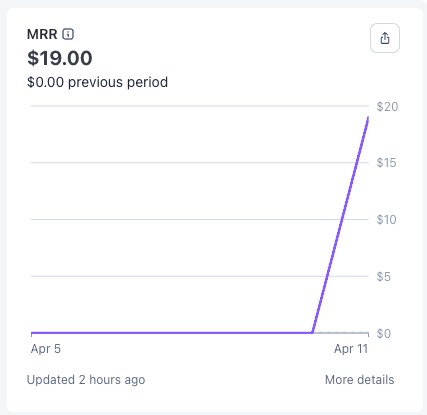
I am a first-time founder. A few weeks ago I shipped a SaaS called Avalidate. Last week, exactly one month after I wrote the first line of code, I got my first paying customer.
No audience. No email list. No Twitter following. No “build in public” community to lean on. I am still a full-time software engineer at my day job, building this on early mornings, late nights, and weekends.
The thirty-day numbers: 2 weeks of building, 70+ trial users from Reddit, 6 video calls, 1 paying customer, $19 in monthly recurring revenue.
Here is exactly what I did, in the order I did it.
I built the thing in two weeks
The app is called Avalidate. You give it an idea in a sentence, and a few minutes later you get back a structured report on whether real people actually want it. Search trends, Reddit threads, Hacker News discussions, competitor pages, all the corners of the internet where people complain about the problem you are trying to solve. It tells you who the buyers are, where they hang out, what they say they would pay, and where the existing players are leaving gaps you could walk into.
I did not really validate the idea before I started building it, which is funny in a way I did not appreciate at the time. Part of the reason was that, honestly, I did not know how to actually validate, other than follow Reddit’s advice — build and ship fast, get real users. So I just built the thing I wished I had every time I had an idea I was not sure about. I figured if it was useful to me it would probably be useful to other founders, and if it was not I would find out soon enough.
I went and found my own users by hand
This is the part everyone is told to do, and based on the constant “how do I find users” posts, a lot of founders still struggle with it. I did not run ads. I did not buy a list. I did not wait for SEO. I went to where my users live, which for me was Reddit, and I started actual conversations.
r/SaaS, r/Startups, r/EntrepreneurRideAlong, r/SideProject. Anywhere founders were already talking about the problem I was trying to solve. I posted, I replied, I sent DMs to anyone who looked like a fit. If you hang out on those communities, chances are you have seen a comment or even a direct DM from me. The trick was that I used my own app to do the finding for me. Instead of doomscrolling Reddit at midnight trying to spot a relevant thread, Avalidate surfaced the threads with the exact pain language I was looking for and the users actively asking for help with the problem I solve. It turned hours of manual hunting into minutes.
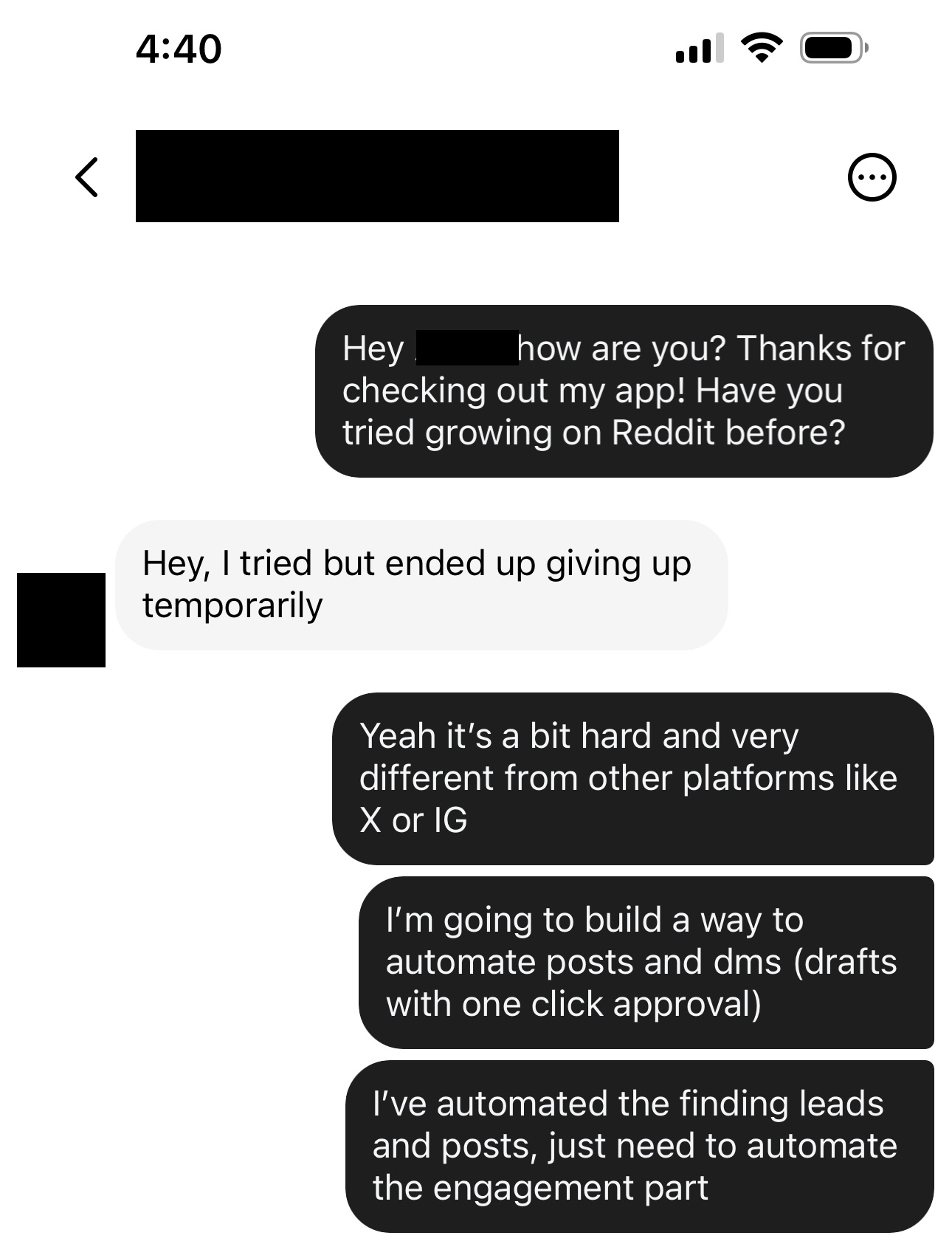 Cold-DMing a founder who said he had tried growing on Reddit and gave up. This is the playbook in motion — and yes, that is one of the seventy.
In a few weeks I had over seventy people trying the app. I went from zero to about a dozen followers on X and sixty on Threads. None of those numbers are impressive on their own, but they were enough.
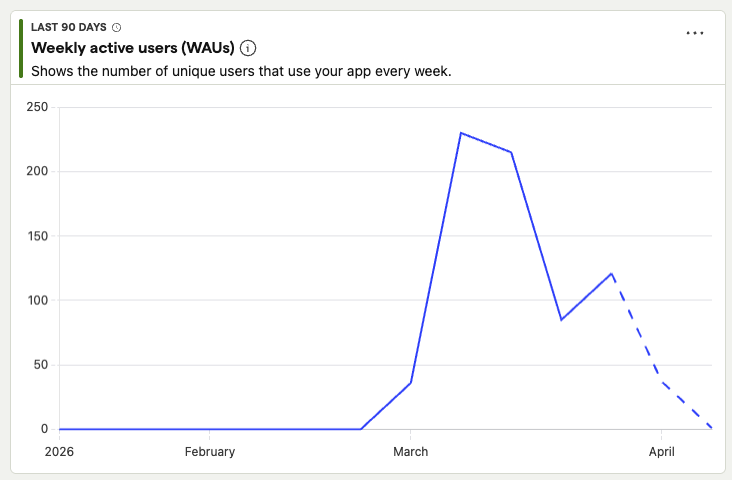 Weekly active users from launch to first paying customer. The spike in March is when I started posting and DMing on Reddit. The drop-off is real. The second wave in April is when the product started getting better.
I got on six calls
Real, one-on-one, video calls. To some, getting in front of a camera and talking to strangers might be exhausting and uncomfortable, and I cannot recommend it enough.
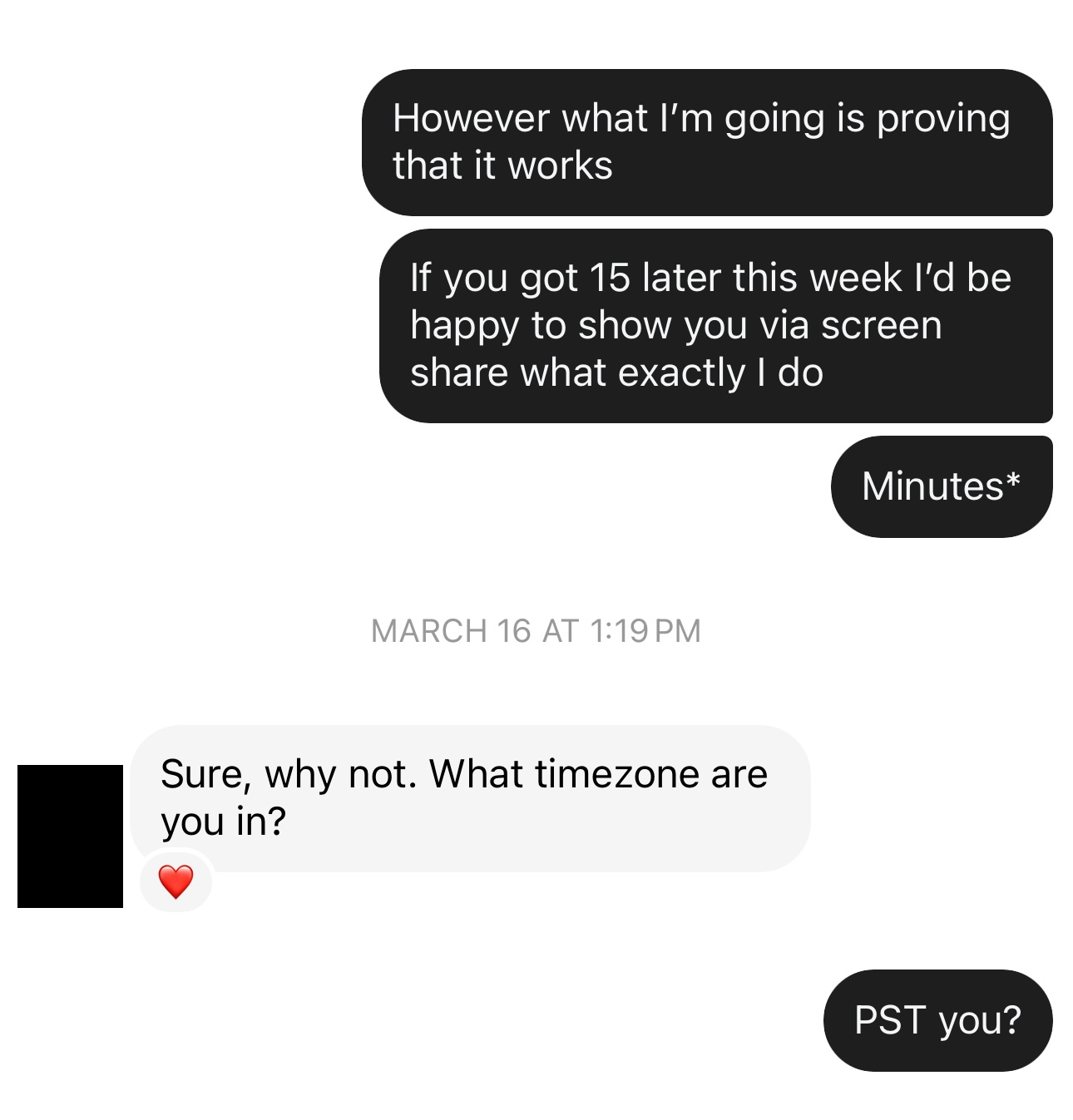 Same thread, a few messages later. He said yes to a 15-minute screen share. This is what the funnel looks like when it actually closes.
Three of those six users gave me feedback I am still building against today. They told me what was confusing, what was missing, what they wished the product did, and which parts already worked. Half of my roadmap right now came directly out of those three conversations. One of those three users paid me.
I built exactly what he asked for
I want to be precise about that call, because it is the kind of moment new founders do not always get to read about. He told me a couple of things he wished the product did. Then almost in passing, he said, “if you can do X and Y, I would pay for this.” I built X and Y. He paid.
That is the loop closing in real time, and I did not understand how rare it is until later. People will tell you they want a feature all day. They will not actually pay you for it. When someone tells you they will pay if you build a specific thing, and you build that specific thing, and they pay, you have found the rarest signal in early stage product development. The only correct response is to drop everything else and listen.
I thought my first paying customer was a bug
I have to tell you how I actually found out. I never set up Stripe alerts. I was deep in the database debugging an issue for that same user when I noticed his account had a Stripe subscription on it. My first reaction was annoyance. Great, I thought. Another bug. Test data leaking into the wrong row.
I clicked into the Stripe dashboard to confirm it was nothing, and there it was. A real charge. From a real person. Nineteen dollars. From the user I was, at that exact moment, debugging the app for. I sat there staring at the screen for a minute, and then a wave of pure joy hit me. A month of endless hacking and late nights had finally been validated. I told my friends and family. Then I went back to fixing his bug.
Where I’m going
I have been treating my first paying customer like a partner from the second the charge went through. He is not a customer in the cold sense of the word. He is the first person who decided that what I made was worth more than the coffee he would have spent the money on, and that is a kind of trust I do not take lightly.
My number one goal right now is to overwhelmingly win over the people already using Avalidate. Even if they end up quitting the app, I want them to leave saying it helped them. I want them to get on their feet and find their own first dollar.
A year from now, I want a hundred people using Avalidate to actually kick off their ideas and actually find their own paying customers. The stats on startup failure are bleak. Most ideas die in silence, without ever being put in front of a real person who could have said yes or no. I do not think I can fix that. But I think I can move the needle a little, for a few people, in the right direction. That is the whole thing. That is what I am building toward.
Frequently Asked Questions
How long does it take to get your first paying SaaS customer?
For most founders it takes much longer than a month, and the reason mine was fast wasn't talent. It was that I shortcut the search by building for founders, who I could find and message anywhere on Reddit. If you're building for an audience that doesn't have an obvious community, expect three to six months. The number that actually matters is not time-to-first-dollar. It is time from "I shipped something" to "I had a real conversation with a real user." That should happen in week one.
How do you find your first SaaS users without an audience?
The biggest mistake first-time founders make on Reddit is not "not posting enough." It is posting like a marketer. Do not drop links. Do not pitch. Look for someone describing the exact problem your product solves, and offer to help them solve it for free, with no strings. Half the time they will ask what you do anyway. The other half you will learn something about their problem you could not have learned any other way. Both outcomes are wins.
Should a first-time founder do customer calls before launch?
The thing nobody tells you about customer calls is that they get dramatically easier after the first three. By my fourth call I could tell within ninety seconds whether someone was a real fit or just curious. Calls one through three are expensive — you ramble, you go over time, you do not know what to ask. Push through those three. After that they become the single most efficient research tool you have, and the only one that catches the things people will not type into a survey.
How much should you charge your first SaaS customer?
If you want the cleanest possible signal from your first customer, resist the urge to offer a deep discount or a lifetime deal to land them. A lifetime dealer is not really a customer — they are a free tester with a check attached, and every piece of feedback they give you is contaminated by the fact that they got a deal. Charging your real price, even if the product is barely there, gives you a much sharper read on whether the thing is actually working.
Did you validate your idea before building it?
Validation is overrated as a checklist you complete before building, and underrated as a mode you work in long-term in the early stages. Every commit, every reply, every call is a validation event. The founders who fail are not the ones who skipped a validation phase. They are the ones who never let a single user contradict the version of the product they had built in their head.
Validate Your Startup Idea
Avalidate analyzes real discussions across Reddit, Hacker News, and niche communities to surface pain signals, warm leads, and competitive gaps for your idea.
Try Avalidate free